How Kyle Garrahy Made 101 Sales in a Shifting Market Using AI and His CRM
The Shifting Market Playbook, session 3 of 3
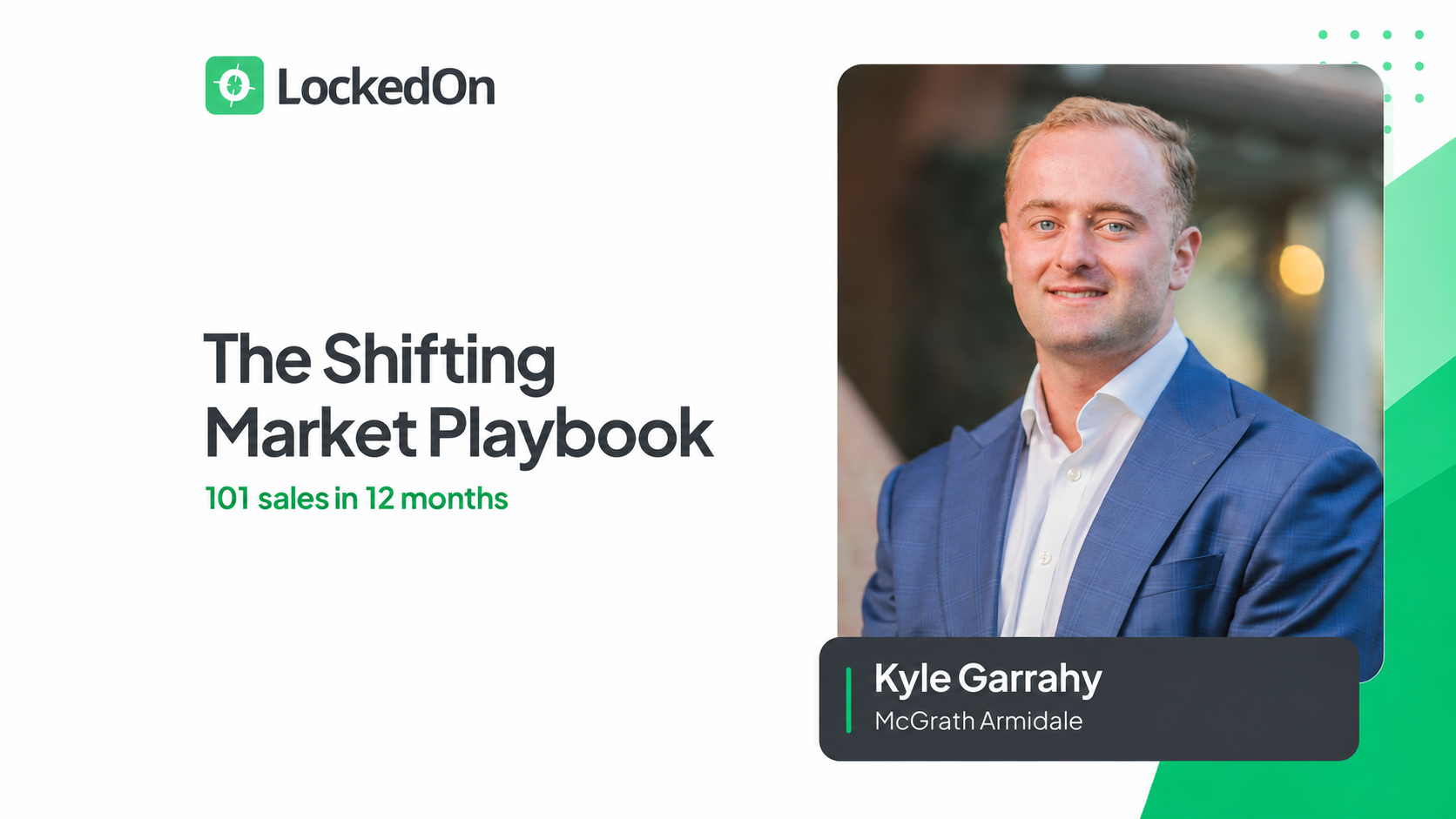
101 sales in the last 12 months. At 27, Kyle is a principal and director at McGrath Armidale. I've known him since his junior agent days, and he's built his business on two things: hard work and smart systems.
In the final session of the Shifting Market Playbook, Kyle walked us through exactly how he manages vendors, keeps buyers coming and uses LockedOn automation to do the work that used to eat his week.
Key takeaways
- Kyle grows his business with 3 levers: time, conversion and leverage.
- An automated anniversary SMS books him 3 to 4 appraisals a week without picking up the phone.
- Your automation is only as good as your data: use dates you collected and contacts who've agreed to hear from you.
- List, educate, sell. Informed vendors make informed decisions.
- Benchmark every campaign and put it in writing, so price talks start from facts, not opinions.
- Make buyers the chaser again by telling every buyer when negotiations start.
Want to see the systems Kyle runs? Book a LockedOn demo.
What are the 3 levers that grow your sales?
Kyle keeps it simple. There are only three things you can scale:
- Time. You can always work harder, but only to a point. There are only so many hours in the day.
- Conversion. Measure it, then lift it with training and better dialogue.
- Leverage. More results without more hours or a higher conversion rate.
Most agents only pull the first lever. Kyle's biggest gains this year came from the third: the systems he runs in LockedOn.
How do you book appraisals without picking up the phone?
Kyle's definition of a potential seller is simple: anyone with a pulse, a property and a phone number. At some stage, that person will sell.
Kyle logs purchase anniversaries in his database. On that date, each owner gets an automated SMS from him:
"Congratulations on the anniversary of your purchase. I hope you're still loving it there. This is usually a really good time to get an appraisal done. Would you like me to do that for you?"
The result: at least 3 to 4 appraisals a week from his 1,400 potential sellers, without making a call.
Across the office, with about 5,000 people in the database, that's around 13 messages a day going out, whether the agents feel like prospecting that day or not.
Is a text as good as a phone call? No. But compared to what? Compared to nothing, it's light years ahead. It's a safety net, not a replacement. Kyle still makes the call:
"G'day, it's Kyle. I was just going through some notes. Can't believe it's been six years already. How crazy is that? What I do for most of my clients at this time of year is an updated market appraisal. Would you like me to send one over?"
Haven't been there for a while? He asks, "Has anything changed with the property?" Never been there? "When can I come around and give you a quick update? It'll only take about five minutes."
How do you set up your anniversary follow-up?
So you might say to me, "Aaron, my data's a mess. I've been flat out listing and selling and I haven't kept up." The good news is you're probably not alone.
Clean data comes first. An anniversary text only works if the person still owns the home and the date is right. Here's how to set it up:
- Start with your own records. Your past sales, your appraisals, and owners who've told you when they bought. Use dates your agency collected directly.
- Check who you can message. Only include people who've agreed to hear from you. Every text should say who it's from and give an easy way to opt out.
- Work one street or estate at a time. Confirm the owner, the mobile and the purchase date before you add anyone.
- Add the dates in LockedOn and switch on the automation (anniversary of purchase or anniversary of appraisal). From then on, it runs on its own.
- Keep collecting dates. Every appraisal and every owner conversation is a chance to confirm when they bought and update the record.
One rule: don't upload data from a paid property data service into an AI tool, or use it to build marketing lists. Check your data provider's terms first. Pricefinder's, for one, rule out both.
Principals: set this up for your whole team. You're far better off having it running than not.
How do you manage vendors when stock is sitting?
Kyle's approach is list, educate, then sell. He doesn't like the word "condition". He'd rather educate.
"Informed vendors make informed decisions. Uninformed vendors make uninformed decisions."
Here's how he keeps his vendors informed:
- Get your week-two buyers through in week one. Kyle runs a one-to-two-week off-market preview with the buyers he knows will come and give an offer, even a low one. It gives the vendor real feedback and a real number to compare against, other than their own opinion. Then he packs the first and second opens with every hot buyer the team has.
- Put expectations in writing before the campaign starts. A "welcome to the marketplace" document explains what to expect, with FAQs like "What if my uncle says it's not a good time to sell?" A second expectations document sets your benchmarks: people at the first, second and third opens, second inspections, contract requests and offers. Miss them, and that's underperformance. Underperformance means an adjustment, usually somewhere between 5% and 15%.
- Ask permission to be honest. At the listing presentation, Kyle asks, "Some of the feedback will be confronting. How honest would you like me to be?" Nobody asks you to lie to them. Then pass on every piece of feedback without bias: "It's not my opinion. It's what the buyers are saying."
- Send it in writing and let them sleep on it. In the moment, you get an emotional reaction. In writing, you get a thought-through response. They talk it over with their partner, and the next day they're far more open to the price conversation.
- Level up your vendor report. Kyle's LockedOn vendor report now carries every buyer's feedback, relevant news on the market, realestate.com.au Ignite reports benchmarked above or below where the campaign should be, and his own market tracking (more on that below). "People can lie, but numbers won't." If engagement is below average, it's the marketing or the price. Max out the marketing first. If it still isn't moving, it can only be price.
- Test the price without asking "Have you reviewed your position?" Try this: "I've got a buyer at 650. I know that's a bit under what you wanted. Would you like me to bring them through?" It's not up to you to decide. Let the vendor say yes or no.
And present every offer, good, bad or indifferent. One offer might not be the knockout punch. It might just be the jab.
How do you show vendors that "wait and see isn't free"?
This is the one Kyle called game-changing. He tracks his own market and puts three things in every vendor report:
- The trajectory: where the vendor's value is now, and where it's heading if the market keeps moving the same way.
- Stock levels: how many properties are on the market now compared with when they listed.
- Price reductions: how many agents are adjusting each week, and by how much.
Here's what he found. He used to recommend 5% to 10% adjustments. The average reduction in his market was 13%. Other agents were having better price conversations than he was.
Now his vendors see that number every week, before they need to hear it. The result? Vendors ring him first: "I've been doing some research on the market, and I think I need to adjust."
How to track it: take a snapshot of the competing listings in your area, then update it every week: how many are for sale, how many have reduced and by how much. Work from public listings and your own campaign records, and never paste data from a paid property data service into an AI tool.
Two prompts that put your AI research on steroids (my tips from the session):
- "Prioritise exchange data." When you ask AI about the market, it tends to lean on settled sales, which can be three to five months old. Tell it to prioritise the most recent exchanged sales and to show its sources. Tell it what you want, and let it figure out how.
- "Present this at a 5th-grade level." AI loves turning things into a university thesis. Simple wins, especially for vendors who don't live in property every day or who speak English as a second language.
And a dialogue I heard from an auctioneer recently: "Your expectation as the seller doesn't set the value. It sets the amount of traffic you'll get."
How do you get buyers chasing again?
Right now buyers are the prize, and they know it. They're being chased. Your job is to make them the chaser again.
- Work your buyer list every week. Kyle's team runs their buyer database in LockedOn, with buyers assigned to each agent. Each week they build a hit list, sit down together for two hours and call the next 100 buyers. You can only know a few hundred people well. Your CRM remembers the rest.
- Dangle the carrot. Buyers are ghosting. If they don't answer, text, but don't give it all away: "Got a property I think is perfect for you. Just give me a call."
- Ask the qualifying question: "What's the last property you made an offer on?"
- Drive your own traffic. "If you're relying on organic traffic through the door right now, you're completely doing it wrong." Every Friday afternoon, the team runs a hit session to book buyers into the weekend's opens, and every open gets a bulk SMS to buyers.
- Invite the neighbours. A bulk SMS and letterbox drop to the owners around the open. They're your future sellers, and they fill the room. A busy open says "there's interest here". One or two people says "no one's interested, so why should I be?"
- Try Sunday opens. With about 100 opens on a weekend in his area and almost nobody opening on Sundays, two or three hours on a Sunday morning means more buyers, no competition, and vendors who can see how hard you're working.
How do you negotiate when buyers think they hold the cards?
- Tell every buyer when negotiations start. Kyle sends a bulk SMS: "Negotiations have started. If you wish to be included, please SMS back yes and I'll be in touch." He never says where the numbers are.
- Ask the binary question: "Is this where you intend to start the negotiations, or where you're hoping to finish them?"
- Then ask: "Are we positioning ourselves right now to be the buyer of this property, or are we trying to get a deal?" Then sit in the silence.
- The line to write down: "The fairer you are with the owner at the start, the fairer they'll be with you at the end."
- Break it down to the ridiculous. The gap is usually $10,000 to $30,000. On a home loan, that's a few dollars a day, about the price of a coffee. "We're talking about the cost of a cup of coffee. Really? We're buying a house."
What should you do in the next 7 days?
Kyle's answers to my three closing questions:
- Get an offer on as many listings as you can. Most agents have plenty of listings. The problem is they're not sellable listings. Take every real offer or real buyer back to your vendors. You'll find a lot of them are far more aligned than you think.
- Stop protecting your vendors' feelings. Deliver it kindly, but give them the truth and nothing but the truth.
- Pull all three levers. Work hard. Lift your conversion with coaching and better dialogue. Then build leverage: if you need 20 appraisals, automate 10 and call for 10, and spend the time you get back with buyers and vendors.
Why does Kyle run his business on LockedOn?
Kyle has worked in 3 or 4 different CRMs. Here's what he told everyone on the session:
"I've used about 3 or 4 different CRMs, and I'd have to say that LockedOn probably has the most user-friendly database. It has the best UI for an agent... This isn't paid sponsorship. I'm getting nothing out of this... I honestly believe that LockedOn is the best CRM that you can be using for real estate."
Everything Kyle shared in this session runs in LockedOn:
- Anniversary of purchase and anniversary of appraisal automations
- Vendor reports that carry buyer feedback and your benchmarks
- The buyer database, assigned buyers and weekly hit lists
- Bulk SMS and email newsletters
- Your database split into areas, so every open home invite goes to the right streets
If you love your database, keep using it. If you think there could be something better out there, come and see what LockedOn looks like.
Frequently asked questions
What is an anniversary automation in a real estate CRM?
An automated message that goes out on the anniversary of someone's purchase or last appraisal, inviting them to get an updated appraisal. In LockedOn it's built in: add the dates and switch it on.
Where should anniversary dates come from?
From records your agency collected itself: your own sales, your appraisals and owners who've told you when they bought. Only message people who've agreed to hear from you, and give them an easy way to opt out.
What should a vendor report include in a shifting market?
Every buyer's feedback, your campaign benchmarks (opens, second inspections, contract requests and offers), portal reports, and your own local numbers on stock levels and price reductions.
What is exchange data, and why does it matter?
Exchange data is sales where contracts have exchanged but not yet settled. It's months more current than settled data, so it shows where the market is today.
How do I get more people to my open homes?
Don't rely on portal traffic. Call your buyers every week, run a Friday hit session, invite the neighbours, and open when your competitors don't, like Sunday mornings.
About the author
Aaron Shiner is one of Australia's most in-demand real estate coaches, with 26 years in real estate. He coaches leading agencies and top performers across Australia and New Zealand, and hosts LockedOn's Shifting Market Playbook series.
Kyle Garrahy is a principal and director at McGrath Armidale, NSW, with 101 sales in the last 12 months. Got a referral for Armidale? Kyle's happy to chat.
List. Sell. Repeat.

Related posts









Done reading? Let’s start winning.
Tips and strategies are a great start, but the right tech makes them stick. Book a free, no-pressure demo and we’ll show you how.